Saturday, March 3, 2012

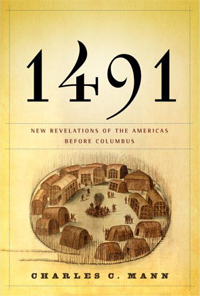
1491: new revelations of the Americas before Columbus


The book aims to change the popular view about the native American people before the advent of the Europeans. (I do not think Indians are the right term to denote them, despite the author’s  rationale.) There are two popular views about the native Americans: 1) uncultivated primitive people with a wretched level of technology, or 2) the noble savages. Roughly, my view about them was aligned with the second category, even though my view differs a lot from the vanilla version of the noble savages. I thought of them as people who gained wisdom to live with the nature, rather than being ignorant of living in the capitalistic ways.

The big questions are as follows: 1) was America really a vacant place with small populace? 2) were the native Americans technologically behind the old world? 3) did the Europeans enlighten the native Americans, leading to a better way of life?

Of course, the answers to all those questions are NO. The population of the Americas before Columbus is an on-going issue of debate, but many evidences show that the continent was rather densely populated. The massacre by the European diseases was of a magnitude much bigger than usually imagined. It is almost sure that the population was reduced to less than half the original size solely due to the epidemic. In some extreme cases like Plymouth, the death ratio was roughly 95%. I am sure nobody these days buys into the rationale of the Europeans settling in a vacant continent, but the take-away should be realizing the magnitude of the tragedy done by the separately developed diseases and viruses. As the author says, if the Americas had had their own hoofed creatures like pigs, the pandemic would have been two-directional instead, killing much of the population in Eurasia as well.

About the second question, the author’s exemplification with the case of plow is very cogent. Before they adopted the Chinese version, the European plow was extremely inefficient, even though it is so hard to imagine that the Europeans could not discover the simple twitch. The same goes for the American civilizations. They had wheels, but only for children’s toys! Though unimaginable to us who are accustomed to the use of wheels, things can happen that way. Another insight is, like anything else, technological and scientific advancement is also relative. For example, the super-complex alloying technology the Incans used for their gold ornaments are simply amazing. As an even more important example, the North American natives’ political systems of having each gender taking care of different affairs of social life, is at least much more advanced than the political systems of most European countries in the 19th century.

The answer to the final question is apparent when we have answers for the first two questions. Ben Franklin wrote the following: Native Americans who were kidnapped early in their lives who were educated in the European way, will desert into the wild once they know of the way of living of her native people. On the other hand, European people who were kidnapped young to live among the natives, even though they learn about the European way of living, will not change the way of their lives. Even though they are taken by force to join their European relatives, they will seek opportunities to escape and return to the native American’s way of life. One might recall the move Dance with Wolves. The reason behind this phenomenon would be apparent: human beings seek happiness by nature.

Even though this book aims to repel the myth of noble savage concept of native Americans, I believe we are back to about the same position in the altitude/latitude. The native American people, living by themselves for thousands of years, acquired a different way of living - which might be less desirable for some of us, but more so for some others. Understanding and accepting differences is the least we human beings must be able to do to call ourselves sentient beings, I believe.

Monday, February 13, 2012

Superstring Theory: So You Wanna Be the Hero?


Whatever the result, I’ve finished reading The Elegant Universe by Brian Greene, on January 28th, 2012. It was a difficult book to follow, primarily because the theory itself is difficult, but also because the book is poorly written. Quite often the author says something he want to communicate is easily demonstrated mathematically, but hard to show in any other way. Of course, that is a valid statement because string theory has so much math in it: it almost started with mathematics. However, I would like to ask Mr. Greene, what are you doing here? Wasn’t this a science book for laymen?

I just encountered so many additional question marks while I was reading this book. So I googled about this and that - for example, Calabi-Yau spaces, and even watched the TBC documentaries starring Brian Greene. We learn better by teaching - communicating what we understand. I will attempt that in the following paragraphs.

1. Theory of Everything

Superstring theory is one of the contenders to become the Theories of Everything (TOE), which tries to fill the gap between quantum physics and general relativity. Three out of four basic forces in nature - strong and weak interactions and electromagnetic forces - are unified under the standard model of elementary particle physics. However, gravity could not be unified in the standard model. TOE is expected to do this task, and the Superstring theory is one candidate for the job. I like the Superstring theory explanation on the zero mass of graviton. Strings can perfectly eradicate mass when two (or more, in a collective manner) strings cancel each other out to become zero wave magnitude. As per Fineman’s theory, wave patterns spread to all directions at the same time. Hence, zero wave amplitude (i.e. zero mass) for the particle that mediates gravity.

2. Dimensions

There are 10 or 11 dimensions in the universe according to the Superstring theory. To be more exact, 10 according to vanilla String theory, and 11 for the M-Theory. Since 1 dimension is for time, there are still 9 or 10 spatial dimensions in the universe. Why six more? Greene says it’s math. Anyway, only three dimensions expanded in the inflation phase of the Big Bang, and the remnant remained curled in the tiny tiny space of the pre-Big Bang universe.

3. Black Holes

Brian Greene allocates a whole chapter to the black holes. Black holes are indeed the testing ground for a Theory of Everything, since the black holes are where the theory of general relativity and that of quantum physics must meet. In general, general relativity deals with the vast universe - the macro level of the universe, while the quantum physics deals with the microworld of Planck scale. They do not cross each other. However, in a black hole, which has super massive mass-energy in a ultra tiny dimension, the two theories must come up with a coherent explanation that does not counter each other. The standard model could not do this, so there are several contenders for the Theory of Everything - including the Superstring theory. According to the Superstring theory, a possible wreck of the space-time dimension - i.e. a singularity point - can be described as being looped by a single string. This can explain the stability of a singularity point existing in the universe. What if the singularity point is too large to be covered by a single string? Here comes the (to my thought) the most thrilling part of the theory.

4. T-Duality

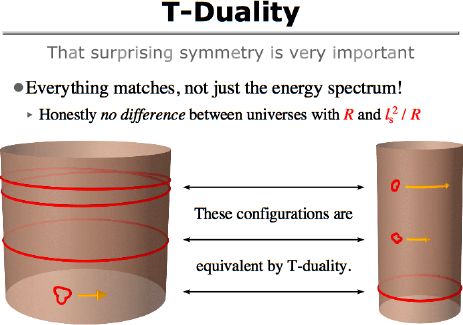
A very surprising revelation by the Superstring theory is that there is no measurable difference between a really small universe and an extremely large one. More exactly, the theory states that a string that loops around a dimension smaller than itself and a string that move along larger dimensions do not have measurable differences. In technical terms, a string with a wavelength of x and momentum y in a universe with radius R, will be basically identical to a string with a wavelength of y, a momentum of x in a universe with a radius of 1/R. See the picture below.

(Picture courtesy of http://www.slimy.com/~steuard/research/MITClub2004/slide29.html)

In other words once more, things happening in a dimension of R does not differ from things happening in a dimension of 1/R. To illustrate this in an interesting way, we might actually be living in a tiny universe with a infinitesimally small size. This micro universe does not show any detectable difference from a immensely vast universe.

5. Criticism

Superstring theory has many shortfalls as well. Most notably, the formulas for Superstring theory yields infinite numbers of solutions. Another problem is this theory is almost impossible to test via experiments. The energy level required to test the theory is said to require a particle accelerator with the size of our Solar system!

Saturday, January 7, 2012

Global Warming with the Ice Age Coming


Many scientists claim that we are long past the due date in getting back to the Ice Age. I also encountered so many people who say that the global warming can be a good countermeasure against the planet's tendency to cool itself. Of course, I do not think this argument is worth countering. I do not think either that there is a serious scientist who puts forward this kind of unsophisticated statement.

However, I am reading Bill Bryson's A Short History of Nearly Everything, and I encountered a wonderful line about the above-mentioned comment, which goes like this: "When you are confronted with a fluctuating and unpredictable climate, the last thing you want to do is to conduct a vast unsupervised experiment on it."

Of course, there are other, more scientific arguments, for example, that a rising temperature might induce an ice age by making more clouds with expedited evaporation. However, I think the argument above is more than sufficient to counter such a naive speculation.

To sum it up, we human race do not understand the delicate eco-system. However, it is much better (and safer) to contain our efforts to reducing our impact on the planet, than to tinker around it.

Tuesday, January 3, 2012

Books that I Read in 2011


Wrapping up the year 2011, I would like to write a brief review on the books that I read in 2011.
   - Best Non-Fiction: The Selfish Gene by Richard Dawkins
   - Best Fiction: Hard-Boiled Wonderland and the End of the World by Murakami Haruki
  - Worst Non-Fiction: Permission Marketing by Seth Godin
  - Worst Fiction: 1Q84 by Murakami Haruki

The Selfish Gene (Richard Dawkins) was the best non-fiction book that I read in 2011. I have never read any serious book on Darwinism before, so this book was enlightening, not to mention fun to read. Many questions we have about the very nature of life, such as the difference between genders, are explained clearly, succinctly, and very persuasively.

Kafka on the Shore (Murakami Haruki) was the first Murakami that I read in 2011, and was good enough to induce me to read more of his works. Unfortunately, this novel also suffers from the author's habitual anachronistic Modernism. But the overall lyrical development of the plot is so nice that the damage from the anachronism is minimal . Like his many other novels, Kafka on the Shore has the structure of parallel narratives: one by Kafka, the other by Nakata. Kafka’s part is mostly lyrical, while Nakata’s part is mostly in the realm of fantasy. When the two parts are interwoven well, Murakami saves the day, as in this novel. However, Hard-Boiled Wonderland and the End of the World (Murakami Haruki) is better in this aspect, hence is the best Murakami that I have ever read. The parallel narratives are sewn together at the perfect moment. Most of all, I really like the final scene, where the protagonist decides not to join his shadow in escaping from the End of the World. This is an utterly selfless act on the protagonist’s side, which is extremely hard to find in any other Murakami’s novels. After Dark (Murakami Haruki) was a short novel I relished reading. This one is quite unique in that the author stays at a firm distance from what is happening in the scene. 

1Q84 (Murakami Haruki) is the worst Murakami, probably even worse than Norwegian Wood. Easily, this would be one of the worst novels written by anybody. I do not think this novel is worth criticism, but to make a point, I will give only one example: at the end of the story, the author says that the protagonists went through a terrible ordeal. This is a thing authors should never even think of doing. Authors should depict the ordeal, instead of saying that it was an ordeal. It should be left to the audience to decide if the ordeal was terrible or not, or if there was an ordeal at all. When Aomame had no real threat to her well-being throughout her hide-away except clumsy Ushikawa, to say that she went through a terrible ordeal does nothing but to make readers utter some scornful laugh. Remedios the Beauty, from One Hundred Years of Solitude, is given sufficient description about her beauty so that the readers do not feel awkward when she literally ascends to the heaven. It would have been ridiculous if Gabriel Garcia Marquez had only insisted that Remedios was beautiful, without actually describing all the events. In short, Murakami must have described the ordeal, instead of saying that it was a terrible ordeal. Anyone can say that his story is fantastic. But this kind of statement is unnecessary if the statement is true. If it is false, the statement will do nothing but drawing derision. Wind-Up Bird Chronicle (Murakami Haruki) was another piece by Murakami that I didn’t like. I wrote a rather lengthy blog post about what I did not like about this novel. But this one is much better than 1Q84, about which I could not even rally initiatives to write a detailed review.

Another novel I enjoyed reading was The Shining (Stephen King). I liked it so much that I went after the movie as well, which was a big disappointment. The novel is set in a stage so small that it contains only a handful of people - but the depth of each character is so rich, like some Greek tragedies. The psychological development of what is happening inside and outside of each character is described with such vividness that you can imagine the scenes in your mind while reading (hence the big disappointment with the movie).
The Tipping Point (Malcolm Gladwell) is what I liked best among Gladwell’s books. The logic is most plausible, and the take-away is relatively concrete. What makes people so crazy about Gladwell’s books is the wonderful story-making based on solid research, strewn with statistics. The flip side of this is the danger of putting the cart (stories) in front of the horse (arguments), and losing focus. Outliers (Malcolm Gladwell) and Blink (Malcolm Gladwell) are books that fell in the trap. Perhaps the storytelling has a negative correlation with the logic of what he tells, since Blink, which has the worst logic and no take-away at all, has the most riveting story lines. What the Dog Saw (Malcolm Gladwell) is another very fun-to-read stuff. However, the articles are only briefly inspirational and the theme is not pursued thoroughly. Of course, this is natural because the book is a bundle-up of Gladwell’s blog postings and published articles. Still, this book is full of food for thoughts, and very fun to read.
Permission Marketing (Seth Godin) came into my radar when I was looking for a good marketing book. Seth Godin must be a good marketer himself because he seems to be selling this contentless book very well. The book reiterates what everybody knows, in such a way that you won’t even remember a thing after reading it.

Good to Great (Jim Collins) was on the top seat of a marketing books list that I found by googling. This book is well written with solid research. But can it be used to make a good company a great one? It can, in the sense that a self-help book can make you a different person. It contains many findings that might take you by surprise - for example, that you cannot change the people you have, and that you should fire them before tackling the task of going from good to great - but most take-aways are not concrete enough to be taken into action.

When I decided to read The Story of Stuff (Annie Leonard), I was looking forward to many interesting facts about the stuffs we use in everyday life, like how much CO2 is generated to manufacture a can of Coke. In other words, I expected a micro-level stories, but I found none - it was a macro-level story. Except that, the book itself is a very well written book with persuasive macroscopic views about consumerism. It gives you tons of food for thoughts.

Willpower: Rediscovering the Greatest Human Strength (Roy Baumeister & John Tierney) is a new kid on the block, and it got spotlights instantly when it was published. The book itself is a result of a lengthy research by two professors. It contains results of many interesting experiments. However, the action items presented by the book are rather weak and vague. But again, there are tons of books on procrastination with even weaker propositions. The book is interesting, and makes you think once more about how you do things.

Black Swan (Nassim Taleb). I’ve been hearing about this book for a long time, and finally found the time to read it. Of course, I totally agree with Taleb in that the tail is thicker and longer than we expect them to be. So what? His arguments are repetitive, and his suggestions are abstract at best. Worst of all, his unsophisticated sarcasm drives people away from his arguments.

The Big History (The Teaching Company) is an audiobook that describes what the author calls a Big History - from the Big Bang to the 20th century human history, and surprisingly enough, beyond. The author is a history professor with Russian history major, but he clearly shows good understanding of astronomy, physics, chemistry, paleontology, and archaeology. Best of all, this audiobook achieves what it aims to do: it gives you the really big picture of everything - well enough to make you think about the meaning of everything. This audiobook made me read The Selfish Gene and A Short History of Nearly Everything.

A Short History of Nearly Everything (Bill Bryson) is basically about the Big History. This book was on my mind vaguely for a long time, since it was introduced in The Economist magazine in 2003. Somehow, only a week ago I came to grab it. This book is different from The Big History in that it focuses more on the development of the theories and the academic development behind the big history, telling more about the scientists who found the secrets of the universe. The book is also full of good humors, unlike The Black Swan. I am only half way through this book yet, but I can tell that this one is a good read.
Saturday, December 31, 2011

Groupon: Cheap is Not a Brand


OK, Groupon finally got the fancy IPO that has long been waited for. Groupon got the place of big winner in the year-end special edition of Canadian Business. Yet, the name of Groupon do not sound as appealing as Twitter or LinkedIn, not to mention Facebook or Apple.

Some while ago, I read a very persuasive writing by Bruce Philip, a.k.a. Brand Cowboy, a blogger and consultant, who talked about Groupon, in Canadian Business. (This article was published before the IPO.)

Groupon has been a beloved icon of social commerce. When Groupon rejected Google’s billion-dollar buyout offer, the majority opinion was that Groupon was wise to pursue its own way in its golden path, and I was not the exception. But these days, I hear things I’ve been hearing about Reach In Motion, on Groupon. Still, I thought those statements about Groupon was on comparative basis. When I heard that Groupon is running low on cash, I thought that their cash reserve came down to several billions from tens of billions. But Brand Cowboy’s posting corrected my stance about Groupon for good.

In Korea, actually, the business model of social commerce is making a lot of nasty noises. Social credibility, I believe, is one of the society’s maturity indices. In this regard, South Korea is still in par with those countries with lower scores. Consequently, businesses often come up with less than what is promised on the coupons when people come to redeem them. This has been broadcast several times in the mass media, but is not corrected. Nowadays, people seem to think of social commerce as semi-scam, or at best, a raffle of a sort. In short, the business model of social commerce is on the downward path, experts say.

Then what about Groupon? Brand Cowboy says being cheap is not a brand. What Groupon does is not differentiated from myriads of its competitions. Groupon’s argument is you must buy because you don’t want to miss a bargain. I have hoards of things (mostly electronics and boardgames) that sit in the attic of my mom’s house, most of which I spent less than a few days playing with. Sometimes I bought them out of curiosity, but quite often, I bought them because they were on sale. As Brand Cowboy puts it, this is surely a less desirable aspect of human nature. And Groupon’s business model is based on that aspect.

Cheap is not enough. Groupon has first-mover advantages, most notably, larger subscription base than any other followers. But this is not a sustainable strength, because there is no distinct network externality in social commerce. Groupon must find a way to make it to the future, and one way of doing it might lie in building a sustainable brand.

Friday, December 30, 2011

1Q84 - Do NOT read it


I am writing this to save people's time by the tons. 1Q84, by Murakami Haruki, was surely one of those lucky books that took space in many people's reading list this year. But, I will save your time - Do NOT read this terrible book. It took me over a month to finish this book, only to find that I came across the worst book by Murakami, perhaps even worse than Norwegian Wood. It almost feels like I've finished the Twilight saga. Then again, that one made sense at least.

It is pointless to list what are so bad with this book, since I could not really find anything good to mention. Murakami wrote this novel in three parts, publishing books 1 and 2 first and publishing book 3 after about a year. I am not sure - whether he is easily swayed by the public's reception or simply he does not have what it takes to finish what he has started. However, he created a total mess of immature curiosity (I feel sorry for the word curiosity, for goodness's sake), then could not make a plausible meaning out of the havoc.

In conclusion, do NOT read it, and you will save 40+ hours, which can be put to much better use.

Monday, December 19, 2011

Corporate Bond Credit Risk - A Very Long-Term Perspective

The National (of course, American) Bureau of Economic Research recently published a paper titled “Corporate Bond Default Risk: A 150-Year Perspective,” which CBS MoneyWatch summarized in an article. I could not access the paper free of charge because I could not fit in any category, but I believe the summary by CBS is worth noting. So here it goes: my summary of the CBS summary, plus some thoughts of mine for those numbers.

The long-run average default risk, for the period of 1866-2008 is 1.5% - a rather high number if you ask me. They are not just listed companies - but they are powerful enough to issue bonds. During the Great Depression, the default rate was well over 10%, but this is nothing compared to the whopping 36% default during the railroad crisis of 1873-1875. Without these outliers, the average will be smaller.

Default events had weak correlation (about .26) with business downturns. Recession indicators have little predictive ability with regard to corporate defaults. Defaults showed their own patterns over time, and had a cycle of about 3.2 years, which is longer than the business cycle.

The credit spread was only 1.53%. I think this is already quite small, but the realized premium for the spread was only .8%. Realized premium was quite low compared to the yield the bonds had when purchased. This is natural, because the yield is there to compensate for all kinds of risks - default, illiquidity, risks from embedded options if any, etc. Yield never equals expected return, but investors confuse them and keep chasing after high-yield bonds.

This, coupled with the 2012 investment outlook from Canadian Business (dated Jan 23, 2012), perhaps we should go with equities, and entrench ourselves in the long-term perspective, and behave like an institutional investor. Most of the companies listed in NYSE today, I believe, will still be there after 20 years.